Zeta Tau Amazon: a sorority girl learns a lesson in the jungle

by Annie Pace
October, 2010

Summer 2009

I can’t remember how to drive a car. I can’t remember what Burger King French fries taste like. I can’t even remember what it feels like to take a warm shower. As my hair is tied back in a sloppy ponytail and matted to my forehead from sweat I try to recall what it was like to have perfectly curled hair for sorority meetings. I look down at my feet and see a distinct flip-flop tan line somewhat faded by the layer of dirt gathered from walking barefoot. I try to remember what it felt like to wear high heels. Squishing the moist rainforest dirt, as black as coal, between my toes, I don’t know why I wanted to put my feet through high-heel torture to begin with. I look back towards our hut and see a child climbing a palm tree to get fruit for me. As she swings back down easily I laugh as I try to recall what it looked like to see children playing on monkey bars back home. Children in the Amazon rainforest play in the monkey’s homes, among the monkeys themselves. A month ago I would have thought these people had nothing. Now, I realize I envy what I once saw as “nothing,” and am so thankful these people brought me into their life, and made me see everything contained in that “nothing.”

It has been more than a year since I was in the Brazilian Amazon rainforest. As far back as I can remember my anthropologist dad had wanted me to accompany him on a research field study. In the spring of 2009, when the time came to make my decision, I decided I was ready. I had been away at college for two years, gotten accustomed to doing my own laundry somewhat regularly, had learned to cook a decent grilled cheese sandwich without setting off the fire alarm, and realized the importance of saving my money instead of buying that really cool bubble machine.

I finally felt mature enough to handle an entire summer in another country, thrown face first into a different culture. Always one for trying new things just to get the experience and to live life, I was excited. However, I was also fearful. I was scared I would miss out on a summer at home with friends. I didn’t want to come back to school feeling regret. In fact, this fear would materialize as I found myself sitting in my room in Brazil listening to country music and missing home.

As a 19-year-old girl, my college life, friends, and sorority sisters were all I knew, and, worse, all I thought I needed to know. I didn’t realize what else the world could offer. It’s ironic that it took the wisdom of a three-year-old girl to make me change my mind. And, in fact, to change my life.

Her name was Edwarda. She was the first person I was introduced to in the small town of Gurupa, Brazil.

We had spent two days on a boat on the Amazon River to get to Gurupa. The boat was no cruise ship. Bedrooms were non-existent; we slept in hammocks hanging every which way on an open deck.
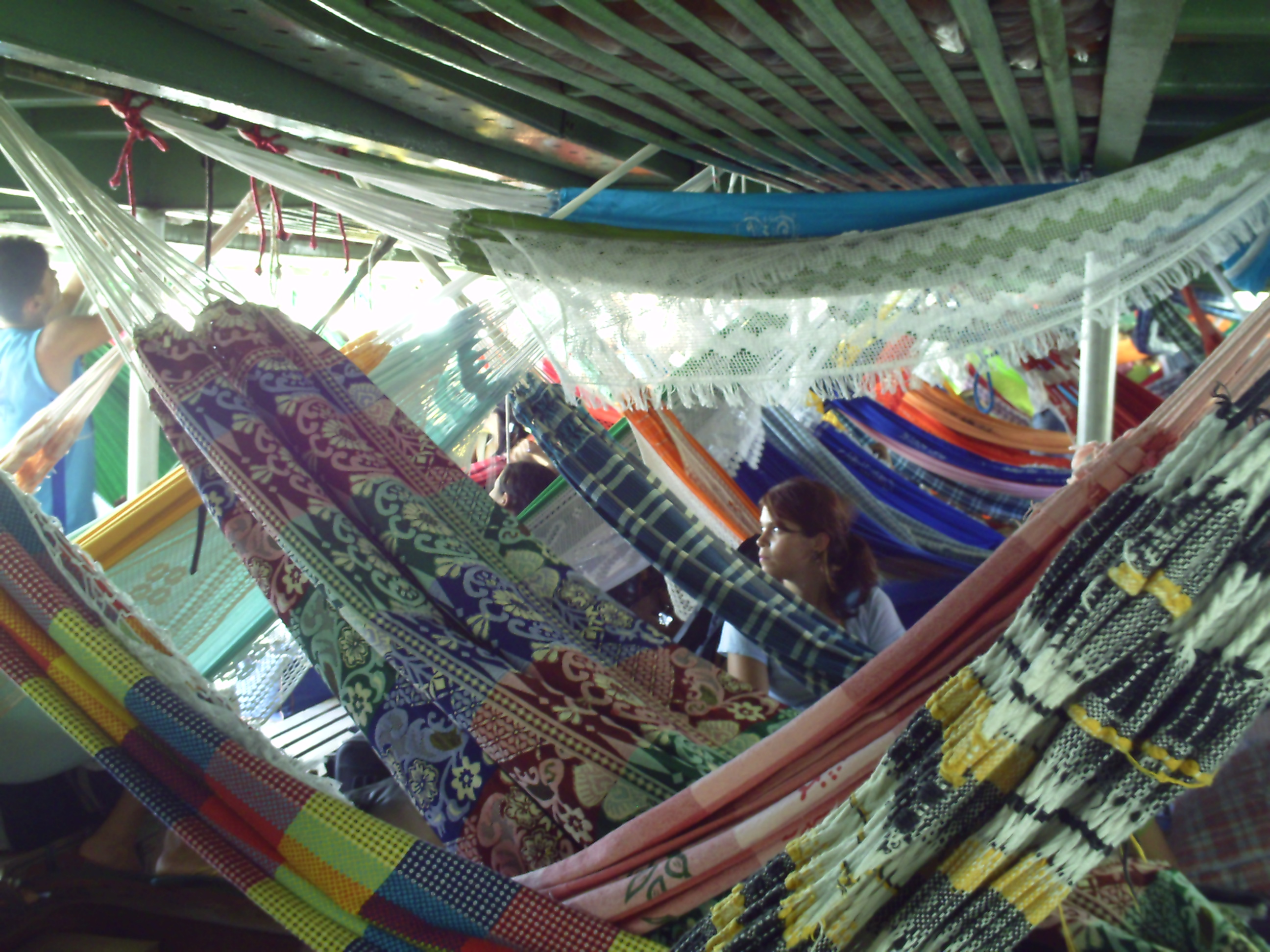
Sleeping quarters on the boat deck

Sleeping quarters on the boat deck

Expert boat travelers would scramble amongst the colorful chaos, the sardine-packed crowd, to hang hammocks above hammocks, just to create a spot away from the intense sun. Bathrooms worked half the time, and the other half they would overflow just below our hammocks. Showers were available, but you tended to smell worse after using them.

The engine in the boat failed constantly, and when we finally got to Gurupa it was the middle of the night. After an uncomfortable few hours of sleep in the sticky Brazilian humidity, I woke in the morning in an unfamiliar house. I scrambled out of my hammock, took a cold shower – all that was available, of course – and sat down, disoriented, at the table. That’s when a little barefoot girl wearing only underwear, hair a tangled black mess, ran up to me. I couldn’t help but think she looked like a young female version of Mowgli from The Jungle Book, a wild rainforest child. Our eyes met, she smiled slyly. Then she grabbed my breakfast roll, and ran away screaming. This was Edwarda.

After that stolen roll, we bonded. For the rest of the summer, every time I would feel scared in the jungle, she would go ahead of me and show me how things are done. Anytime I would feel out of place, she would hug my leg and call me her sister. She was independent and wasn’t scared of anything.

Gurupa, on the Amazon River island of Marajo

Gurupa, on the island of Marajo

She loved what she had with all her heart and wouldn’t let anything endanger that love. One time a stray dog came up and sniffed my hand as we were walking down a dirt road. Edwarda, thinking it might hurt me, took off her flowered flip flop and, holding it high in the air, started chasing the dog, screaming in Portuguese for it to get away from her sister.

My new family didn’t have a car, didn’t have much clothing, or very much of anything. But Edwarda made it fun to ride around on a bike instead of getting to places in a timely matter with the air conditioner blowing. She made it fun to get down in the dirt then wash it off by playing in the rain, not caring if you looked like a mess at the end of the day. She didn’t worry about people judging her or living up to someone else’s expectations. She didn’t even know what that meant.

If we wanted fruit, we’d climb a tree and get it. Then we’d pick enough for the rest of the kids in the town. If we wanted to go for a dip in the swimming hole, we’d catch a bike ride from a friendly neighbor and walk back with new friends.

Edwarda with her new sunglasses

Edwarda with her new sunglasses

If we wanted an adventure, we’d paddle down a creek in a tiny wooden canoe, frequently  with the sporadic but intense Amazon rainstorms pounding down on us. Edwarda lived life on a moment’s notice, and held my hand and dragged me along for the ride.

When I came home from Brazil my friends and family greeted me warmly, and I realized at that moment I hadn’t missed a thing. Yes, maybe adventures in Tennessee occurred while I was gone, but I had my own adventure of life and self-discovery. And my friends and family were waiting to hear all my stories and welcome me back.

I also learned from a small person with a large personality that it’s fun to be yourself, get a little dirty, and that material things are not as important as I thought.

Edwarda, with only three years of life wisdom, understood what was important, and she protected it. Now anytime I walk around campus at night with a friend, I will have that flip flop in the air and ready.
Memories from a long journey

by Kate Greer

February 19, 2010

If everything goes as planned, I will be one of several thousand students receiving diplomas from the University of Tennessee at Knoxville this spring.  Like the other graduates, I will be handed a piece of paper representing several years of hard work. But my journey to reach my degree started differently than that of the other graduates.
It started in Vietnam, where the equatorial sun hangs heavy and unmoving in the sky year-round.  Where the tropical heat suffocates strangers but the sun-beaten peasants toil endless hours, scratching out a living from the soil beneath their feet.

Like our rural neighbors, my family worked the ground as well.  We were farmers of every kind of produce in the unremarkable village of Bien Hoa, just north of the capital, Ho Chi Minh City.  At the time, I was too young to work the fields.  I couldn’t walk yet, but my sisters, about three and four years older, were already helping my parents with the crops.  They harvested what the land brought forth and what kept malnutrition at bay.
But then our mother unexpectedly died from a lightning strike. Our father mourned the loss of his wife and the loss of the extra pair of working hands. The farm began to fail and our household fell apart. Without my mother’s smiling face, our roadside shack was no longer a home.  My sisters took over my care while my father struggled to find a new way of living.

For a while, our father sent us to live on our grandparents’ farm.  But their household was already full and there was little room for three more children.  Our next stop was a nearby orphanage. This foreign place with whitewashed walls became our home.  The orphanage was operated by Catholic nuns who schooled us in their religion as they provided a basic education.  The facility was primitive – a pocket of wildness in this era of civilization.

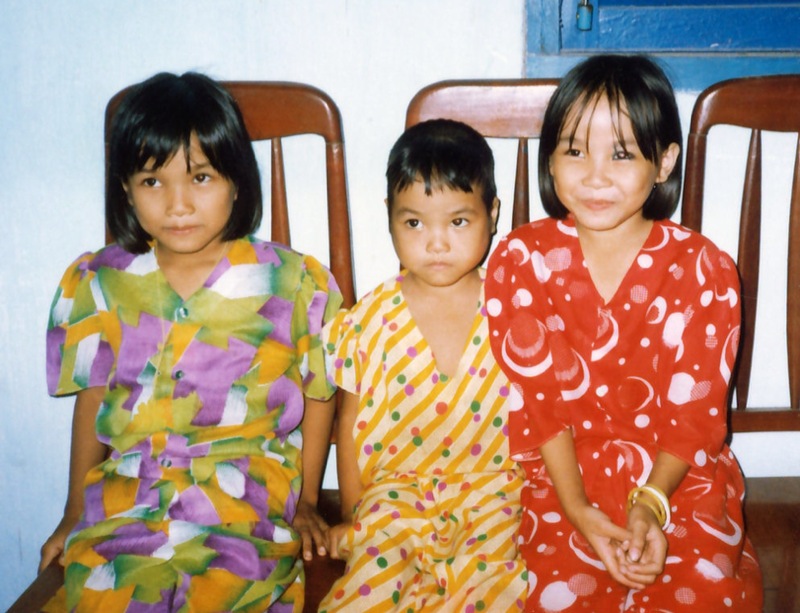
Flanked by my sisters, Kelsey and Haley

Flanked by my sisters, Kelsey and Haley

The toilets didn’t work and the older children were expected to help the nuns with looking after the smaller children.  My oldest sister has the worst memories of having to wash the cloth diapers used and reused by the babies.  The cloth diapers, along with the rest of our laundry, was dried on clothes lines in the courtyard.  We ran barefoot underneath them to the cafeteria, where a stockpot sat with whatever the nuns could cook during the babies’ nap time.

But most of my memories from this chapter of my life are lost to space and time.  I was about five and my sisters were seven and eight by the time we were adopted, according to the official documents from the orphanage.  Older children were next to impossible to adopt away, and for someone to adopt three or more siblings together was unheard of, but we suspect that the nuns’ wish for a better life for their wayward children led them to lie about our ages.  By Vietnamese standards, we were normal size, but an American family looking at us would see puny children who could pass for much younger than their birth mother would proclaim.

Though my memories from this time are few, there are some bright splashes of color that seemingly have no significance but are more vivid to me than the faces of my biological parents. I can remember our father coming to visit us regularly at the orphanage.  With his motorbike, he would take us out to eat on the streets, which in Vietnam is a cornucopia of food vendors, their offerings ranging from wild game like monkey to the traditional Pho noodle soup. As the youngest of the sisters and the puniest, I always sat on my father’s lap with the gas gauge underneath while my sisters clung to our father’s back, our raven hair waving in the wind. Those visits were the only times I’ve ever been on a motorcycle.

But for me, the most vibrant memory of that time was running to meet the lady with the smiling round face who weekly came to sell delicious noodles, a treat for the kids at the orphanage.  We ate the noodles like American children would eat candy.

Our father’s second wedding, with his new wife, also remains with me.  The new woman was well-off by the standards for our small Vietnamese village, which meant our father was no longer playing a game of Pick-Up Sticks with poverty.  They married while we were at the orphanage.  My sisters and I were invited to the wedding, and although most of the traditional, ceremonial things happened, I only remember a white frou-frou dress that cocooned my body into a walking, talking cotton ball – until it met its demise when a traditional red dipping sauce was spilt down the front.

I do not recall much else.  The task of remembering is like looking at a photograph from the 1800s, faded and yellow with no smiles on anyone’s faces.

My sisters and I were growing up, a joyous process for most children, but it meant it would be more difficult for the three of us to be adopted together.  But Tim and Pam Greer from Soddy-Daisy, Tennessee, a 30-minute drive outside of Chattanooga, decided to adopt all of us. It was an expensive and time-consuming process.

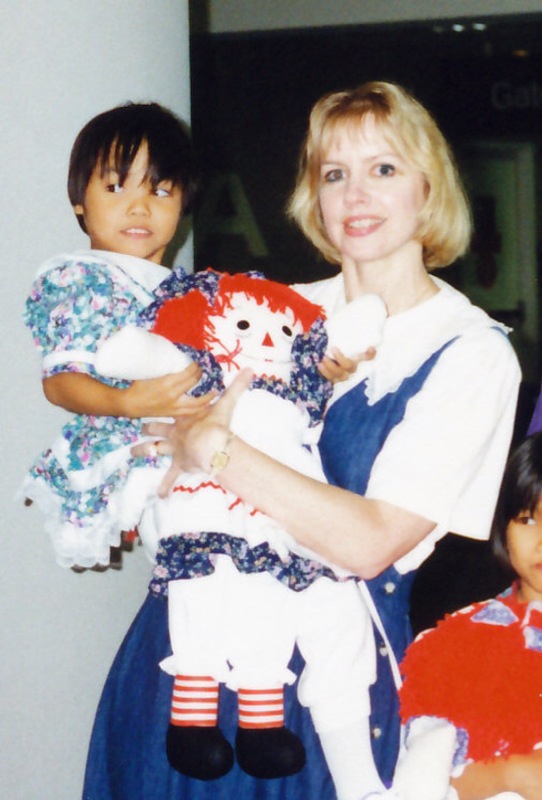
With my new mom and the doll she made me

With my new mom and my new doll

But finally, September 6, 1994, we arrived in America, now our home.  Our new mother, clever with her hands, had made each of us a doll to commemorate the event.  Our parents drove to the airport with three inert dolls buckled into their newly purchased mini-van.  They came home with three animated girls, no bigger than their doll toys.

It was that simple.  Our father had found himself a new wife and family to belong to, and so had my sisters and I.

From this moment, my life truly began.  I’ve been blessed with the opportunity to be raised in America with all of its chances to grow as an individual, chances that Vietnam could not offer.  The Chattanooga airport was our Ellis Island – it held the hope and promise of a better life.

America gave me a chance to complete my education, a chance to choose a career outside of the home, a chance to not live day-by-day scratching out a meager existence. Instead, I’m receiving my Bachelor’s of Science in Communication for journalism and electronic media from The University of Tennessee May 2010.  I could never be where I am today without the courage of my adoptive parents to save my sisters and me from the empty life we would have lived in Vietnam.

My opportunities have opened my eyes and heart, and I have made it my life’s ambition to return the favor that adoption has given me to the rest of the world.
I believe correct information can empower people and ignorance is the strongest weapon the enemy has against us.  In this manner, I hope that my career as a journalist, and whatever else my future might hold, can educate and improve the lives of as many people as possible.

After graduation

After graduation

As an international journalist, I could reach out to more people.  My dream is not of fame or riches but of leaving a lasting impression upon the world that not all hope is lost.  This is my aspiration, but I have many miles to go before I sleep.

Somewhere inside all of us lives our younger and better self.  As I graduate college and begin searching for the next chapter of my life, I feel more like the scared little girl that I started out as, unsure about what is in store. It is in these moments that I remember my heritage and my unique story.  Although my doll, carefully sewn with love and embroidered with my name and anniversary of coming to America, might not have been my favorite plaything growing up, today I cherish its significance.

Rod and I go to the game

Marie’s Olde Towne Tavern, despite the gentrified spellings, is an unremarkable joint on the north edge of downtown Knoxville, with the clientele one would expect from its location only a block from the Greyhound bus station.

But Marie’s does sport one thing that no other bar in town does. On the wall there is a framed, autographed photo of former University of Tennessee football player Rod Harkleroad. And on this October Saturday Rod insisted that I experience it. “I gave them an exclusive, so it’s the only bar in town where you can see it,” he said.

The year was 2002 and I was accompanying Rod on his ritualistic game-day circuit.

I had known Rod since grammar school – he and I had knocked helmets for a couple of years when we were about 12 or 13. Because we were the two biggest guys of our group, we always did the choosing when teams were picked. When we became semi-organized, with regular Friday-afternoon games, he quarterbacked the Stompers, I led the Bruisers. We played in the side yard of Danny Meador’s house, our only equipment being the ball and, for some, helmets. We imagined our games were the talk of Burlington, the working-class east Knoxville neighborhood where we lived.

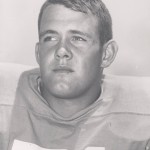
Rod in his Vol uniform, 1964

Rod had gone on to play high school football, had made all-state as a senior and had received a scholarship to the University of Tennessee. He didn’t play much – on the depth chart, he was behind Bob Johnson, now enshrined in the College Football Hall of Fame. But Rod was active in the Vols’ Lettermen’s Club and kept up with his old teammates.

I was trying to find a different perspective for a story on UT football and had decided that hanging out with the old players prior to a game could work. Rod liked the idea and agreed to get me inside the Lettermen’s Club before a game.

We decided on the Arkansas contest because its 8 p.m. kickoff would give us plenty of hanging-out time. And that’s why we were at the Olde Towne at 1 p.m. Marie’s was our third stop of the day. Rod, after a successful career coaching high school football, was now in the food-service business, and he had pre-game meetings with a couple of clients, providing food for their tailgate parties.

First, we made a delivery of yard-long sandwiches from Steamboat, a sub shop owned by another high school pal, Donny Anderson. The delivery was to Jefferson County, northeast of Knoxville. Then, after we had crossed back into Knox County, we stopped at a liquor store.

“I’m going to let you drive,” Rod said. I took the keys to his van and he mixed Jack Daniels and Sprite in a plastic cup. “I’ve got to meet another client at 3 at Riverside Tavern, so we’ve got time to stop by Marie’s.”

After my eyes adjusted to the lack of light in the bar, I found Rod’s picture. He was in full uniform except for his helmet, looking fierce in a dropback blocking stance.  “Nice, huh?” Rod said. “Enough to make me a regular here.”

After we finished our brews and fended off a half dozen entreaties from a beer-begging crone, we left Marie’s. “Swamp Rat’s on the air by now,” Rod said. “And Mrs. Parker needs to call in.”

Swamp Rat was Dewey Warren, who played quarterback for UT when Rod was on the team. He now was host of a call-in sports talk radio show. And Mrs. Parker? That was Rod, using his best soft, refined, feminine voice. We got in the van, Rod got out his cellphone, and soon had Dewey on the line.

“Mr. Warren?” he said. “This is Mrs. Parker and I was just calling to discuss the finer points of the game.”

The Swamp Rat was a legend among the Big Orange faithful, and Mrs. Parker had become a star of his show, especially on game days. Today, Mrs. Parker wanted to talk about quarterback Casey Clausen.

“I am reminded of breakfast time when I was a child,” she said. “We had to be quick if we wanted an extra biscuit. That young Mr. Clausen’s holding the ball too long and that’s why the young men on the other side break through and he gets his rear side blistered. He just needs to be quicker in order to get the last biscuit.”

Mr. Warren agreed, thanked Mrs. Parker and turned to another caller.

Mrs. Parker was bang-on in voice and manner, she did not take the game too seriously, and she possessed a propensity for double-entendre that was subtle enough to slip right by Mr. Warren and his producers. The voice disguise was perfect. “You know,” Rod said to me after he hung up, “Dewey didn’t figure out that I was Mrs. Parker until the third or fourth time she was on the show.”

I was now pulling into the parking lot of the Riverside Tavern, a popular spot within walking distance of Neyland Stadium. The Riverside, though it too was a “tavern,” had nothing else in common with Marie’s. The gameday crowd consisted of the more successful Big Orange boosters. True, some might be as drunk as the old woman we had left at Marie’s. And they might be overly friendly, but they were more likely to want to buy a stranger a drink than to try to cadge one.

Rod swapped opinions on the game with his client, and then charmed a tableful of Arkansas fans with a “soooie pig.”

We then set out on foot for the serious tailgaters, it now being only four hours to kickoff. It was too early, Rod said, for much action at the Lettermen’s Club.

There were a couple more client stops and a brief visit with a local politician at his set-up before we made our way to Danny Meador’s spot. Danny, my old Bruiser teammate, was now president of a heavy-equipment firm and ran the company tailgate at UT games.

Rod and I regularly joined Danny and his company crowd, so we were expected. Another of Rod’s UT teammates, Paul Naumoff, would sometimes show up, and they would regale us with football stories. Paul, an all-star linebacker, had spent a decade heading up the defensive unit of the Detroit Lions before returning to Knoxville. During their college days, he and Rod had roomed together.

One of Paul’s favorite stories involved another linebacker, a player who partied with the same abandon that earned him All-American honors on the field. Among the other players, he was also known for his insistence when in search of drinking partners.

“That’s the reason I roomed with Rod,” Paul would say. “When he showed up at 3 a.m. drunk and rowdy, Rod would start preaching and praying for his soul. After a couple of those sessions, he left us alone.”

“But Paul,” Rod would add, “I prayed for your soul, too.”

Several drinks and stories later, Rod and I headed for the Lettermen’s Club – there was barbecue and it was close to 6 p.m. and I was hungry. Inside, I found what I was looking for – though it was not what I expected. Instead of insights into the TV games or the upcoming UT action, mostly what I heard were complaints about “these young guys not knowing how to play the game” or “not being tough enough to win the head-to-head battles.” They groused, I took notes, and Rod visited with former teammates.

Finally, it was 15 minutes until kickoff, the Lettermen’s Club was emptying, and the noise from the nearby stadium was drowning out normal conversation. We set out for our upper-deck seats.

About half-way up the entry ramp, I realized how tired I was. I was game-dayed out. I looked at Rod, who had been going longer than I had and who had drank a pint or so of bourbon to boot. He, too, looked tired.

“Do you really want to sit through three hours of football?” I asked him.

Feigning surprise, he looked at me askance. “You mean you don’t want to listen to my insights before each play? And what about all the folks around my seat – they expect me there to tell them what’s going to happen.”

I had joined Rod at games before, and what he said was true. As soon as the opponent’s defense was set Rod would call the play, and 75 percent of the time he was correct. Then he would regale us with derogatory comments about missed blocks and coverage. A game with Rod was always fun.

Once, I asked Rod why he had quit coaching. At his last job, at a rural school north of Knoxville, he explained, he had been forced to lock himself in his office after a night game and call the sheriff’s department because a father angry at his son’s lack of playing time was waiting outside.

“I decided there had to be a better way to make a living,” he said. “Besides, this way I can just tell everyone how it should be done without having to worry about winning or losing.” So he stayed involved in football, and was especially active with the Lettermen’s Club, helping out when any of his old teammates needed assistance.

But tonight, he was as tired as I was. We did a 360 on the ramp, Star Spangled Banner blaring in the stadium. We heard the roar of the kickoff as we made our way back to the van, and listened to the first few minutes of the game on the radio as I drove back to where my car was parked. Rod assured me that he would sleep in the van until the next morning (his habit after such episodes), and I went home. The next day, I read about UT’s victory. Casey Clausen threw a touchdown pass to Jason Witten in the game’s sixth overtime. The game ended at midnight.

A few months later, Rod was diagnosed with advanced cancer. But that did not stop him from helping an old teammate. Steve Delong, a two-time All-American who had a career in the NFL, had fallen down a flight of stairs. The resultant back injury left him wheelchair-bound. He was in a nursing home, and Rod was a regular visitor, frequently accompanied by other former teammates, including Elliott Gammage.

“Every week, we’d go see him,” Gammage recalled recently. “Steve was angry about his circumstances, but what Rod meant to Steve was unbelievable. Here Rod was dying of cancer, but he had time to visit Steve every week. Rod Harkleroad demonstrated the kind of courage that I pray I’ll have when I’m near the end.”

A couple of weeks before Rod’s death, Danny Meador and I visited him at home. In pain, he was in a lounge chair, his reactions slowed by painkillers. His wife Brenda, a nurse, was at work. A woman we didn’t know met us at the door.

“I’m Rod’s first wife,” she said. “Second,” Rod corrected her.

“We couldn’t live together,” she said with a smile. “But we’re still friends.”

He turned to us. “It’s tough when you’re dying, fellas,” he said. “They even bring in your ex-wives.” We all laughed, finding comfort in knowing that he hadn’t lost his sense of humor.

At Rod’s memorial service, dozens of former UT footballers showed up. Tales were told and there was a lot of laughter. One former teammate, Mike Price, repeated a favorite story, one that all the players knew. Rod, Mike, and Art Galiffa, a quarterback on the team during the mid-‘60s, were quail hunting one fall.

“We were taking a break, headed back to the trucks,” Price said. “Art and I had gotten in front of the others when one of the dogs went on point behind us. I hear a gun go off and next thing I know I’m on the ground and blood’s going everywhere. They start trying to find where I’ve been shot, undoing my coveralls. Rod’s hysterical. We can’t find where the blood’s coming from. Finally I look at my hand and see that a pellet has gone through my thumb.

“Rod finally calms down and we head back to the truck to get a Band-Aid. Rod put his arm around my shoulder. ‘You know, Mike’ he said, ‘If I had to shoot anyone, I’m glad it was you’.”

‘Why?’ I wanted to know. ‘Why not Galiffa – I mean, he’s a cocky quarterback’.”

“Because,” Rod answered, “You’re such a nice guy.”

Several days after Rod’s death, several of his old teammates managed to fulfill one of his last wishes. They slipped into Neyland Stadium and surreptitiously scattered his ashes around Shields-Watkins Field.

“It’s good to know,” said Price, “that Rod’s there to tell the coaches when they’re messing up.”

Doc & the cowboy

As a college student in the 1960s, I supplemented my income, and my education, by working as a reporter for a local newspaper. The combination led to my initial first-hand encounter with abortion, then a shadowy, illegal practice. The place was the University of Tennessee in Knoxville, where I lived off campus in a dilapidated two-story building popular with students.
My introduction to the area’s abortion specialist came through a neighbor, an animal-science major. Though the ridges and valleys of East Tennessee are far removed from the cattle-raising plains of the West, Roy was a true cowboy. A senior in his early 20s, he already was a successful rancher, leasing pasturage in a nearby county for his beef cattle. In his junior year he had sold one-third of a blue-ribbon bull for $10,000, testament to the animal’s breeding potential.
Roy exhibited Hollywood-cowboy traits, too. He was taciturn when sober and rowdy when drunk. And he was known to carry a .38 revolver.
A behest from Roy led to my discovery of the Doc. The Doc was a general practitioner whose office hours were 5 to 9 p.m. three days a week. His office was on the fringe of downtown, less than a mile from our apartments. (In this story, he will be called the Doc; the other names have been changed.)
Roy had come to me in an uncharacteristic panic. He had gotten a girl pregnant and he asked if I knew where she could get an abortion. Roy knew that I had contacts through my job. I worked at The Knoxville Journal, the morning daily.
I asked the Journal’s police reporter, he obtained the Doc’s name from friends at the cop shop and I passed the information along. I didn’t see Roy for a couple of weeks, and I assumed that he and his girlfriend had visited the Doc.
But the Doc’s name came up again a few weeks later when my friend Stanley came to me with the same problem. His girlfriend Jeannie was pregnant.
Stanley and Jeannie were involved in a more stable relationship than Roy was. When Jeannie’s pregnancy had been confirmed, they had decided not to have the baby. Stanley wasn’t mature enough for fatherhood and Jeannie was well aware of that. Indeed, a couple of months later, Stanley would be making another trip to the Doc’s – with another girlfriend.
In 1967, the options available to those confronted with an unwanted pregnancy were limited. The Pill had been available for a few years, but to most it was still a novelty, controversial. Roe v. Wade was five years away.
Knoxville had a home run by the Florence Crittenton agency, a national organization founded in 1896 to provide a discreet place where unwed mothers-to-be could stay during their last three months of pregnancy. But Knoxville girls, at least those with the means, usually opted to spend their pregnancies at Crittenton facilities in Nashville or Memphis, returning after the baby had been adopted. That way the pregnancy could be kept quiet, their absence explained as an extended visit with relatives or, in the case of one of my friends, as a lengthy treatment for a mysterious “infection.” Such visits depended on having the contacts, and on being able to take time away from jobs or school.
Another option was the Mexican abortion – Tijuana was popular. But Mexico is a long way from Knoxville, and Jeannie could not miss work.
The Doc provided another option. Most cities, even those in the 200,000-population range like Knoxville, had a doctor or two whose specialty was abortion. As I recall, the Doc’s fee was $200. For Stanley, the trip to the Doc simply meant a month or two of drinking less, catching his executive father in a generous mood with a convincing story, or borrowing the money from friends. Stanley cadged the $200 from a fraternity brother and made an appointment. Immediately after the procedure, Jeannie, pale and shaken, rested in my apartment; the Doc had no recovery facilities and Stanley lived in the frat house.
Later, through my job, I became friends with an emergency-room nurse. She knew about the Doc. And she knew about the girls without the knowledge or the means to visit him. Occasionally, she would be involved in the treatment of a girl who had attempted an abortion either alone or with help, often of the coat-hanger variety. There had not been any recent deaths in Knoxville from such methods, but she had heard stories from veteran co-workers, stories that I did not want to hear.
But that all came later, after Roy’s situation resulted in a first-hand encounter with a time-tested southern Appalachian solution to unexpected pregnancy. Whatever Roy and his girlfriend had decided, her family had their own ideas, and one night shortly after I had sent Stanley to the Doc, I was awakened by yelling outside my window.
The father of Roy’s girlfriend, flanked by his two sons, was facing the building’s second-floor balcony, where Roy was standing, shirtless, revolver in hand. The girl was behind her dad, at the rear of a mud-spattered car that I took to be the family sedan.
The yelling was mostly from Roy and mostly along the lines of “I’m not the one knocked her up.” The father’s arguments were measured, spoken quietly and determinedly. It was evident that the pistol in Roy’s hand was the reason he and his sons had not bounded up the stairs for a more physical confrontation.
As other lights came on in the building, the girl and her family climbed back into the car and retreated. The next day I asked Roy what all the yelling was about. He didn’t say much – just that he didn’t think he would need the abortionist’s services.
I don’t know whether his girlfriend had the baby or not. There could have been a marriage of convenience to a family friend to provide the child a name, or she could have visited a Crittenton home. Roy wasn’t saying. But he did ask me to help him move his cows to another farm, on the other side of Knoxville about 70 miles from the girl’s home county.
A few months later, Roy graduated and moved back home to Virginia. Eventually, the Doc retired – with Roe v. Wade, his services no longer needed.

Writing examples

It would be one of them: Hallett, Levitt, Lowder or Long. It might be the mysterious Richard Hallett, a tiny peanut of a man who refused to have his picture taken or play checkers with anyone smoking. It might be the jovial Leo Levitt, a nuclear physicist from Los Angeles, or quiet Elbert Lowder, a bachelor piano tuner from Sanford, N.C. Or it might be Asa Long of Toledo, Ohio, who had won the title back in 1922, at age 18 and, if he won this tournament as well, would be both the youngest and the oldest man ever named U.S. Checker Champion, therefore embodying the sort of symmetrical statistic beloved by checker men.

— Susan Stewart in Westward magazine


Haim Saban is an Israeli American businessman whose main claim to fame is the Mighty Morphin Power Rangers. A proud partisan, he is one of the biggest benefactors of the Democratic Party and Israel, and yet he remains little known outside the inner circles of power in L.A., Washington and Jerusalem. On a cloudless morning in Beverly Hills, he steps out the front door of his mansion to greet the day. His suit is pluperfect plutocrat, tie platinum, hair slicked back and streaked with stately silver. He is 58 years old, at the happily-ever-after end of a rags-to-riches story. He lives in a cocoon woven of the finest silk, on a six-acre estate in an exclusive gated community in a fantasy version of reality where all doors are opened for him: the front door, the car door, the door to his private jet, most every door he cares to walk through. Saban occasionally opens doors himself, though, with a mixture of charm and insistence. “After you,” he says, standing aside as he ushers me to his waiting Cartier edition Town Car.

— Guy Lawson in GQ magazine.


Nathan Alexander Bickley.  Now there’s a name. It conjures up a definite image, something like that of a graying Boston banker; shrewd, prosperous, dignified, confident but not arrogant, faintly aristocratic. It’s a good, gilt-edged name — exactly the kind of name you’d pick for a man who is executive vice president and paladin for the Dallas Citizens Council.

— Kit Bauman in Westward magazine


On first arriving from Florida, I brought my mother’s face close to mine, slid into a pair of well-worn loafers, some faded dungarees, and a royal blue, zippered sweatshirt; piled the marble-topped coffee table adjacent to the davenport high with long-neglected volumes; walked into the kitchen and from the pantry closet removed a package of Oreo Creme Sandwiches; returned to the living room and flicked on the television, which after a momentary lull began its incessant and hypnotic drone; invited Christie III, my mother’s saucer-eyed, russet-and-white cocker spaniel to share the davenport at my feet, and then lay down until the spring of 1958.

— Frederick Exley in A Fan’s Notes


JR Buchanan knew where the body should be — on the rocks alongside Walker Prong, high on Anakeesta Mountain in Great Smoky Mountains National Park, a couple of miles from the road where the victim had been taken from his car weeks earlier by two murderous companions.

And he knew why it wasn’t there. Animal tracks crisscrossed the sandy spits along the creek, the prints of “five or six different bears.”

Then Mr. Buchanan and his partner, Buck Branam, found a jawbone, a human jawbone. And, in the still eddy pools of the creek, they spotted bits of what looked like skull.

“The bears had gotten the body and tore it apart, carrying it off. They’d cracked the skull open to eat the brains,” says Mr. Buchanan, relishing the detail.

The year was 1981and JR Buchanan (his given name is just the two initials) and Buck Branam were park rangers, back-country specialists brought into the case after one of two suspects told the FBI his companion had taken the victim up the creek and killed him with a blow to the head.

“We had to have the skull to prove the murder,” Mr. Buchanan says.

So he and his partner got down on their hands and knees to look for bear.

“The rocks were covered with moss — we would lift the moss and feel underneath for the imprints on the bottom. We worked our way up the side of the ridge from the creek — crawling — looking for anything unusual.”

Mr. Buchanan’s specialty is looking for things unusual: He’s a tracker, trained in his youth by his grandfather and uncle to track game through the forest. And if you can track bear, turkey and deer, you can track people: poachers, lost hikers, marijuana growers, murderers.

The “unusual” might be a broken twig, an overturned rock, the silvery underside of pine needles. In this case, it meant the cracked and yellowing remains of a human head.


It’s Saturday night and jet foils are pulling into Macau’s ferry terminal every 15 minutes, bearing crowds from Hong Kong and the Chinese city Shenzhen, each about 40 miles distant. A mile to the north, arrivals by land elbow their way toward customs checkpoints in a hall longer than two football fields. By 9 o’clock, visitors will arrive at the rate of some 16,000 an hour. They carry pockets full of cash and very little luggage. Most will stay one day or less. They will spend almost every minute in one of Macao’s 29 casinos. — Smithsonian, by David DeVoss


The death of Case 0996-81 was not very elegant. The 67-year-old man, reeling from a lethal dose of alcohol, galloped among the stripped-down televisions and boxes of junk in his duplex early April 15 and, finally, dropped dead, his chin catching the edge of his mattress and feet pointing straight out on the floor like a ballerina. Case 0996-81 was in hot pursuit of a 58-year-old woman. — Westward magazine, by Ralph Frammolino


“Walk with me,” John Travolta said.

Walk with him? Yeah, right. He didn’t mean walk with him; he meant walk like him, and we all know about his walk, that it is his instrument, and that he owns it. — GQ magazine, by Tom Junod.


My brief career as a private eye

I was working the popcorn stand at the zoo, first day of the fair, first day on the job, when Dickson showed up. He was in his new security-guard uniform. On anyone else, the spiffy, crisp outfit might have looked impressive. But on Dickson, who resembled Woody Allen, it looked comical. Blue pants with white stripes down the outside edge of each leg, white shirt with blue company logo. A blue cop hat with shiny black brim topped off the ensemble, almost overwhelming Dickson’s horn-rimmed spectacles.
Dickson just grinned when I laughed. “You won’t laugh when you hear where I’ve been assigned,” he said.  Though he might have looked like a cartoon version of a cop, he was full of confidence – in fact most times Dickson could not be headed no matter how stupid his scheme of the moment. And Dickson was a schemer.
At fair time, ten days in late summer, we all tried to pick up extra cash with jobs, preferably on the Midway. We still lived at home, in Burlington and Park City, the two neighborhoods of East Knoxville closest to Chilhowee Park, where the East Tennessee Agriculture and Industrial Fair took place every year. My grandparents lived a couple of doors from one of the main entrances and, come fair time, I had parked cars in their yard from about age 8. Now, a couple of years into college, I had graduated to a job inside the fence.
True, my stand at the zoo was about as low as a fair job could get, across the walkway from the animals – two aged lions and a battery of monkeys. But at 7 p.m. I would close up and move to the duck pond on the main route to the Midway, decidedly more in the midst of the action.
Dickson usually had a job parking cars, working for the same security company but without any uniform. They did furnish a flashlight, though. Somehow, he had talked his way into a promotion, and here he was, outfitted seriously, armed with a new flashlight, one of those double-long, four-battery truncheons.
“While you’re playing straight man to a cage full of monkeys,” he said, “starting in a half hour, I’m working behind the girly show on the Midway, making sure no one sneaks in by climbing the fence behind the tent.”
He put a lot of emphasis on that last clause, because we were all familiar with that particular stretch of fence. Before we had gone legit with real jobs at the fair, before we had taken to calling ourselves “carnies,” we had become adept at sneaking into the fairgrounds. The fence behind the girly show had been a favorite – it was dark and off the main roads – until a couple of years earlier when the Midway operators had stationed a guard there. And now Dickson was telling me that he was that guard.
Though the fair featured the usual displays of produce and show animals and community-club food stands, the main attraction was Gooding’s Million Dollar Midway.
Gooding’s brought in the Ferris wheels and Tilt-a-Whirls and I Got It games and freak shows and Guess Your Weight set-ups. And the burlesque show.
So that first night, about 9 p.m. I drifted away from the duck pond and made my way to Dickson’s spot. When the girls were changing costumes, we could almost see more than we could have with a paid ticket and a front-row seat. There was just enough promise to induce neck-stretching and quiet re-positioning.
Of course, when we explained to our friends, we exaggerated, and by the second night we were being joined by three or four others, all of us hunkered down behind the tent. We especially lusted after the long-legged June Knight, the show’s star. And Tondelaya, who was spectacularly configured.

So we spent each night of the fair’s run in goggle-eyed effort at cheap thrills. But the fair only ran for 10 days, and June Knight and Tondelaya were soon on to their next stop.  We returned to our weekend-night routine of cruising the drive-ins, the girly show replaced by awkward efforts at conversation with the girls in the cars next to us at the Pizza Palace or the Tic-Toc.
Then, a couple of weeks after the fair, I got a call from Dickson. He had an assignment, he said, and he wanted to know if I could drive. An assignment?
Yeah, he said, for the security outfit. He was, he informed me, still doing work for them, important work, private-detective work. “You are talking to,” he said, “a full-fledged private dick.” He wanted me to drive, because, he said, he didn’t think his Volkswagen bug was quick enough.
I was driving a 1960 3.4 Litre Jaguar sedan, a giant leap from my previous wheels, the family station wagon. I was the envy of my group, though Vance Walker insisted that his dad’s pink and white1957 Cadillac was faster and cooler. But I had an advantage – the Jag was mine, bought with money I made from my full-time job as a cub reporter at the morning daily. I needed no one’s permission to take it out, as long as I had gas money.
I didn’t take a lot of convincing, and agreed to pick up Dickson in front of his house about 8:30 p.m. on Saturday. He would, he confided mysteriously, fill me in on the way to Maryville. As usual, his mother followed him out the sidewalk, telling him to be careful and to be home early. And, as usual, he acted like she wasn’t even there.
As it turned out we were headed through Maryville, to a service station south of town on U.S. 129. There we were to meet the client, a woman who was trying to gather evidence on her cheating husband.
The woman was accompanied by her sister. They told us to park our car and ride with them. On the short trip Dickson tried to impress the women. “Your husband said anything suspicious?” he wanted to know. “Made any rash moves, done anything stupid?” He mentioned the name Marilee, explaining to me that she was the “other woman.”
“And she’s not even good-looking,” the wronged wife added with a sniff as we pulled into the driveway.
The house was a brick rancher, the basement opening out onto the back yard. Dickson and I quietly crept around to the back while the two women made their way through the house and opened the sliding-glass doors into the basement recreation room.
Dickson had tapped the client’s phone and set up a tape recorder on top of an air-conditioning duct. He needed to change the tape, he said. Fifteen minutes at most, he added.
Just as he was climbing up to reach the recorder, there was a noise upstairs. We froze. The client decided to go see what was going on. Dickson and I, without conferring, decided to go out the sliding-glass door into the woods behind the house. Soon, the woman’s sister rounded us up. False alarm, she said – the cat had knocked over his food dish.

We went back, Dickson changed the tape, and we soon hit the highway for Knoxville. So how do you like being a private eye, Dickson wanted to know. Not much to it, I said – as long as the husband doesn’t show up. Dickson just laughed. “These guys aren’t very smart,” he said, smug in his private-eye persona. “You should hear some of the stupid things he says on the phone when he’s talking to his girlfriend. When he’s not being all smoochy, he’s laughing about his wife not knowing anything.”
My next “assignment” was a stake-out, keeping Dickson company while we sat in his car across the highway from the client’s house. I had convinced him that the VW was less conspicuous than my Jag. I soon found that all the assignments were installing phone taps, changing the tapes, or fidgeting inconspicuously through stakeouts.
The work was steady, and Dickson soon had enough money for a more suitable vehicle. He found a Jag similar to mine, and, in his arrogance, ignored my observation about it being easy to spot. “The people we’re dealing with,” he said, “they don’t know a Jaguar from a ’49 Plymouth.”
Perhaps inevitably, there was a close call during a daytime assignment where he was changing a tape in a basement garage. I was working at my own job and therefore wasn’t along. The suspected adulterer returned home unexpectedly and Dickson had to hide behind the furnace for more than an hour before he could get out. After listening to his tale, told with the braggadocio that only comes after the fact, I decided to get out of the private-dick business, refusing any more “assignments.”
Next time I saw Dickson he was involved in one of Knoxville’s most high-profile divorce cases, a mess that I knew a lot about because of late-night newsroom talk with the police reporters.
The battle was over child custody. The husband, a prominent doctor, was seeking to have his wife declared an unfit mother. She was, according to courthouse scuttlebutt and testimony, sex-crazed. She liked to sun herself nude in their fenced backyard, testimony revealed. She had been known to answer the door without clothes. And, most damning, the maid testified that she had applied ointment to madam’s rug burns, suffered during sex on the floor with a well-known actor who was in Knoxville for the making of a movie.
At first Dickson’s job was tapping the phone for the husband. But by that time, she was coy enough not to reveal anything over the phone lines. The husband and his lawyer decided more drastic measures were needed.
So Dickson and one of our high school buddies, Randall, came up with a plan. Randall’s parents moved in the same circles as the doctor and his wife; he had met the woman a couple of times.

And he had a decent apartment off-campus. He would, he announced, lure her to his place for an assignation. A photographer would then burst in through the unlocked door and, flashbulbs popping, catch the couple in a compromising position. Dickson wanted me to be the photographer. “Money up front,” he said. “And it’s the kind of job that could lead to something big. If this works, the three of us could open our own agency, specializing in high-profile cases just like this one.”
I declined. “Okay,” he said, “but you’ll be sorry after we start working on all kinds of juicy capers. We’ll be like Mike Mannix and you’ll be writing stories about us.” The reference was to a popular television detective.
“Stories about you all being shot,” I answered.

I finally agreed to loan them a camera and show Dickson how to use it. Dickson and Randall then ran through a few practice bust-ins at Randall’s apartment. I stayed away, though I did develop their efforts in the newspaper’s darkroom. After a couple of rolls of film, Dickson finally figured out how to focus the camera on the bed.
But then he made a mistake. He left the pictures on his bedside table and his mother noticed them. “What’s this all about?” she wanted to know. Dickson’s explanations didn’t convince her. She called Randall’s mother. The truth came out. And Dickson’s career as a private dick was at an end. Soon, he was telling me about his new job – as a parking-lot attendant.
“Parked a Corvette the other day,” he informed me with a smirk. “Got rubber all the way across the lot.”

Cooke, Lenny and the hooker


Lenny woke me about noon on a Saturday, early fall, pounding on my apartment door. He was upset.

“Cooke nearly did it last night,” he said. Cooke (all the names have been changed) was a buddy from school. We were all two or three years graduated, and Lenny had spent six months in the Navy until given a medical discharge. I was a junior at the University of Tennessee and Lenny had just enrolled. Cooke, who graduated high school only because the principal was tired of dealing with him, was not exactly college material. He was working a menial job.

The “it” that Lenny was talking about? Cooke was the kind of guy who, consensus had it, would eventually get himself – and whoever happened to be with him – thrown into jail. Our high school’s “Most Likely to End Up in Prison Stripes.”

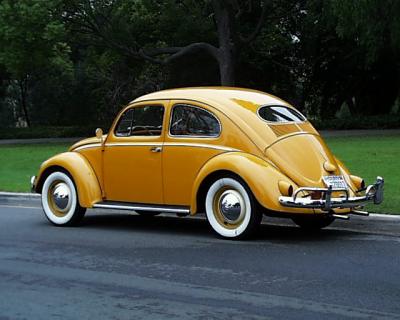
I calmed Lenny and we got into his yellow Volkswagen Beatle and went to Brownie’s on the Strip for a burger – and an explanation. Stories involving Cooke were always interesting. And sometimes frightening. Carefully trying to edge the Bug into a spot too small to be designated for parking, Lenny cursed his car. “It was part of the problem,” he said.

Though he had his own wheels, Lenny was living with his parents, a half-dozen miles from my off-campus apartment. And Cooke, who did not have a car, had shown up at his house about 9 the night before.

They had made the usual rounds: Blue Circle, Pizza Palace, Tic Toc, Shoney’s on Broadway. After filling the gas tank, Lenny said, he was left with a couple of bucks. Cooke said he had five dollars, “so we didn’t do anything except cruise.” They finally landed a back-row spot at the Palace.

Cooke tried talking up a couple of girls, but, Lenny pointed out, it’s hard to get much action when you’re in a yellow VW.

Cooke was a talker all right. And he had a way with the women – until they got to know him. In high school, he convinced one of the teachers, a single woman who had a pristine, big-finned, two-tone 1959 Dodge, into loaning him her car in the afternoon when we were supposed to be in study hall. I accompanied him a couple of times, cruising the drive-ins.
But there weren’t a lot of cruisers out during school hours, and he had to have the car back by the final bell. He did garner attention a couple of times when I was with him, managing to burn rubber in spite of the car’s automatic transmission and push-button gear-shift.

Cooke decided that he and Lenny should go to the Park Hotel and get a hooker. When reminded that he only had five dollars, he insisted that Lenny loan him his two. With seven dollars, he argued, he could get a room and have enough left to pay the hooker.
The Park, on a seedy side street downtown, was the kind of place where such transactions were common. Rooms could be had by the hour.
Lenny argued, he said, throwing up “every objection I could think of — but you know Cooke.” Finally, he told him he would drop him off and then pick him up after a half hour or so. But he had another idea.
“I tell you what,” he said. “I’ll go in, get a room, then go into the bathroom in the lobby and write the room number over the urinal. You come in a few minutes later, tell the bellhop you want to use the bathroom and see what room I’m in and come on up. I’ll tell the bellhop to get me a girl.
“How are you going to pay for the girl, I asked. The room cost five. He said he’d figure something out. I dropped him off, then found a parking spot on the street. Not a lot of people downtown at midnight.” Another head shake.
So then you went into the hotel?
“Yeah, I walked in, nodded at the bellhop and found the bathroom. Sure enough, there was a number written over the urinal. Cooke was on the second floor. I walked back out into the lobby and started for the stairs. But the bellhop was wise to that trick. You ain’t registered here, buddy, he said. Out.”
So you went back to your car?
“And drove around downtown, killing time. Then a cop stopped me. He wanted to know what I was doing. I told him I was supposed to meet a buddy. He told me he didn’t want to see me circling the block again.
“I drove to the Blue Circle, made a few circuits, but didn’t see anybody I knew. Thanks to Cooke, I had no money so I couldn’t even get a Coke. I went back downtown. Same cop pulled me over and told me if he saw ‘this yellow Volkswagen again’ I was going to jail.”
And then?
“Hey, I’m not stupid. I went home. By then it was about 1 a.m. I figured Cooke could take care of himself.”
Well, if nothing else, I pointed out, he had a room for the night.
“Exactly. I went to bed. Sometime after I fell asleep, I heard the screen on the window rattling. It’s Cooke, of course. I’m not about to let him in, so I go out the back door. He’s shirtless. And short of breath. And pissed. Where were you, he wanted to know.
“I told him. He cussed the bellhop. And the cop. And the hooker.”
So the bellhop sent a girl up?
“That’s what he said. She told him she wanted her money up front. And he hemmed and hawed. Turned on all the charm, he said. But he was dealing with Sonya, a girl, he explained, who had seen and heard about everything.”
Sonya was a widely known Knoxville prostitute. And unlikely to be charmed, especially by a cocky 20-year-old.
“So he said she started to leave and he jumped in front of the door. Naturally, she yelled for the bellhop.”
Cooke still had on his clothes?
“He’d taken off his shirt. He was through the door and down the stairs before the bellhop could get from behind the desk. He ran to the Greyhound station on Gay Street and jumped into a cab. The driver took one look at him and asked for cash up front.
“Cooke gave him what he had left – my two bucks. That got him a few blocks out Magnolia. He then ran the six blocks to my house.”
So you took him home?
“Yeah, but I made him push the VW out of the driveway so we wouldn’t wake up my folks. He’ll probably come down with pneumonia, what with being without his shirt, and sweating. He got really pissed when I laughed at him, sitting there in the car shivering.
“When I dropped him off, he said he’s going to get his own wheels. I told him he’d better because he wasn’t getting into my VW again.”


Posted in Memoir Leave a reply

Chasing Aphrodite


Miami in 1972

New York City journalism had recently experienced a major upheaval with many of the dailies closing, sending dozens of staffers heading south for jobs in Florida. Many landed at the Herald, adding to what was already a diverse group of wily veterans, including a refugee or two from pre-Castro Havana.

There was Gene Miller, two-time winner of the Pulitzer Prize for investigative work. When he was present, his loud and dogged phone interviews dominated the newsroom.

At the other end of the spectrum was demure Edna Buchanan, her appearance belying her skill with grisly stories from the police beat; and Jay Maeder, whose laconic demeanor masked a rapier wit which eventually found fruition in a column.

Jim Dance, a talented and eccentric editorial writer, was a fellow native of southern Appalachia. He was from Middlesboro, Ky.

Then there was Ben Hunt, a Brit who had been declared persona non grata in Ian Smith’s Rhodesia for refusing to vote, a requirement for all white residents. He had worked for papers in London, Johannesburg, and Toronto.

It was an interesting mix, making for an interesting publication.

At that time, South Beach wasn’t exactly seedy, but it was years removed from today’s glitz. The atmosphere was traditional beach-boardwalk. A Coney Island habitué would have felt at home – and many of them did.

The south end of the beach gave way to a greyhound-racing track. Many of its patrons were regulars at a bar/restaurant a half block away. The Turf was dark and smoky, an escape from the sun, sand and surf a short walk away. It was close enough to the Herald via MacArthur Causeway that it became one of our regular dinner-break spots. Our usual waitress was a Brooklyn escapee with an accent that was thicker than the burgers.

Another favorite, within walkiing distance of the Herald on Biscayne Boulevard, was the Lobo Lounge, a place that could have been a mainstay of many Brooklyn neighborhoods.

Most often after work, we headed to the North Dade Athletic Club, where the only athletic equipment was a pool table. The hours were the main attraction – as a private club ($5 to join), it stayed open until 3 a.m.

The Herald building was on Biscayne Bay, which meant spectacular views from the east-facing windows. We could watch the seaplanes of Chalk Airlines as they landed on the water. Or the Goodyear blimp, tethered next door to the Chalk facility on Watson Island.  A bit farther south, there were usually several cruise ships tied up at the Port of Miami pier.

That was 40 years ago, and now, in May 2010, I’m beginning a two-month journey to Cyprus, birthplace of Aphrodite, by returning to Miami, where I’ll be boarding one of the successors to those ships. But I’ll be checking out the old Herald neighborhood before sailing. I’m sure my favorite views have changed, my old haunts have disappeared, the tropical funk replaced by sparkle and glamour. Nevertheless, I’m looking forward to seeing Miami again.

Return to Miami

In South Georgia, on Interstate 75 for Florida and Miami, billboards dominate the terrain, touting pecans, peaches, and peanuts. Closer to Tifton, just beyond the sign boosting the “historic”  downtown, spa advertisements take over – there is Lucky Spa, No. 1 Spa, Tokyo Spa (Truckers Welcome). South Georgia is, it appears, about more than fruit and nuts.
Across the state line, roadside scenery quickly changes. North Florida apparently has stricter rules when it comes to billboards. They are there, but not in such numbers. Real estate, a classic Florida sell, is available, at least until horse country starts. Then the interstate cuts through expensive terrain, home to thoroughbred horses and their moneyed owners. Billboards aren’t as welcome.
Ocala  comes and goes as a fierce thunderstorm hits, then it’s the tollway heading east, horse culture giving way to Mouse culture as Orlando looms. I skirt Disney country to the south, leaving its tourist attractions to those more enamored  of rodents and their fascist creators than I am. Back into desolate agriculture country, finally leaving the turnpike for a room in Okeechobee.
The next morning, I head east for Interstate 95, making contact in Palm Beach County at rush hour. Just before 8 a.m. two guys in a convertible speed around me, top down, golf clubs filling up the back seat. This is the Florida I remember.
On the outskirts of Miami, I get off I-95 in favor of Biscayne Boulevard. Little River, where I briefly lived before leaving Miami, is now a Caribbean enclave, a Little Haiti with its bright colors, street-front food vendors and storefronts blaring reggae – or on one occasion, Aretha Franklin. But the seeming prosperity is only evident for a couple of blocks; empty buildings and caved-in roofs speak to a desperate poverty only a few steps off the main drag.
Right onto 36th Street (not easy as Biscayne is torn up with a construction project), to see what remains of the North Dade Athletic Club. There’s the building, sadly boarded up and graffiti-splattered. Not surprising, as the joint’s heyday was 30 years ago.
On to downtown, where new high rises crowd Biscayne Bay. The Herald is still where it was when I worked there – but part of the building is rented to a school. Across the McArthur Causeway to South Beach. No dogtrack, no Turf Bar, just sleek, airy
hipster hangouts instead. But the pedestrian traffic seems to be the same mix, enough weathered retirees that have called it home for decades to offset the young, not-yet-weathered sun worshippers.
And just south of the causeway, tied up at the Port of Miami, is my ship, the Jewel of the Seas. Time to ditch the car and board the boat.
As the ship slips through Governor’s Cut, South Beach to the left, Miami is spectacular in the rear-view mirror, like most cities: beautiful from a distance, not so much from street level. Miami is a tropical metropolis, sunny funkiness edging toward heat-induced rot.


At Sea

The last time I was on board a boat out of Miami, it was a 12-foot Sunfish, property of a fellow Miami Herald employee named Dave Finley. It was my first adventure on a sailboat, and it ended with the Sunfish on its side in the Atlantic off Key Biscayne, Finley and I thrashing around trying to right it as a Coast Guard Albatross circled overhead. We finally got it upright, clambored aboard, and returned to the safety of Biscayne Bay.
The Jewel of the Seas is a bit more of a boat – a cruise ship of the Royal Caribbean line, a gleaming, massive party vessel with a full casino, a theater, several restaurants and bars, two swimming pools, a library, resident acts ranging from magic to musical, and, not to be discounted, two ping-pong tables.
The passengers, headed for Harwich, England, with stops in Bermuda, Lisbon, and Brugge, number about 3,000. Judging from their destination-tagged t-shirts and tote bags, they are a well-traveled bunch: All the expected  Caribbean locations, plus the Falklands, Cape Horn, K2 Pakistan, the Black Sea. When a destination is featured on a t-shirt, it’s no longer remote no matter how far away it may seem.
The British seem to be in the majority, many headed home after South Florida vacations. Out of Miami, weather hot and humid, the outdoor pool is popular, tanners catching the rays. The poolside tableau – when its members were several decades younger – could have starred in an R. Crumb fantasy.
The first few days, before we head north into cooler weather, the pool is the center  of organized activity, with line-dance lessons, bean-bag toss, a putting contest, and the World Male Belly-Flop Championship. The last garners much attention when a female, helped by libations from the Pool Bar, insists on entering, fully clothed. She competes, but loses out to a big-bellied Scotsman.
My dining tablemates – Peggy, Sandy, and Rosa – are all cruise veterans and, natives of the New Orleans area, not easily fooled when it comes to eats. Even as we critique what Royal Caribbean is serving up, we are talking about the best of the Crescent City. I learn to always insist on unwashed oysters (saltier and tastier); that in real Italian households, tomato sauce is called “red  gravy;” and that the best bread pudding is found at the Red Maple in Gretna.
On Mother’s Day, we land in Bermuda, though many are disappointed because downtown Hamilton and its shopping is closed, it being Sunday.
After eight hours ashore, it is back at sea – five days until Lisbon. As we are farther north, it is generally too chilly for poolside activity, though the solarium pool is still available for the serious water sportsmen. So the two ping-pong tables, wind-protected in the verandah, start drawing crowds. As I takie my morning tea at 7:30, I can watch ping-pong. There are even formal-wear games. (Several evenings are designated for formal wear – I do not participate, but am startled one night by a huge Scotsman in tux and kilt, a sight not soon forgotten.)
One of the appeals of a cruise is that it can be an escape. You are among folks that you never have to see again; you can participate in belly-flop competitions in anonymity; you can spend hours in the casino without anyone (except your banker) knowing about it; you can take the stage on amateur night and pretend you’re on American Idol. And, like the man in the kilt, dress however you want.
One Brit, bald and in his 50s, favors an all-red outfit. His sleeveless shirt, mid-calf pants (they used to be called pedal-pushers), and matching Keds wouldn’t be acceptable in any London office, even on casual Friday.
Finally, Lisbon looms. I sign up for a shore excursion to a national park and fishing village south of the city. There is a stop at the Fonseca winery, where I discover that one of their products is an old undergraduate favorite, Lancers. On the tour, Most-Obnoxious title goes to a couple who insist on loudly arguing with each other in the middle of our guide’s commentary.
The coastal scenery is spectacular, wildflowers in bloom, blue sea below. The tortuous cliffside roads make me think of those short States-side news stories: 56 die when bus plunges down Portuguese mountainside. Fortunately, our driver is experienced, his bus in top shape.
Back on board, next stop Brugge. I haven’t been there, but I have spent a lot of time in Brussels and am way too familiar with Belgian chocolate, so I am looking forward to laying in a supply to get me across Europe.
And I want to see the Michaelangelo sculpture housed in the Church of Our Lady. The sculpture, Madonna at Bruge, is reason enough to visit Belgium. Because it’s in a church and not a museum, there is no crowd; I can spend as much time as I want admiring the work of a master.
There is also success on the chocolate front – I pick up a kilo (I would get more but I know it will melt before I get to Greece), and head back to the ship. Our next stop is Harwich, then a short train ride to London, a taxi trip across the city to St. Pancras Station for the EuroStar, the luxurious “Chunnel” train that connects London and Paris in less than two hours.
Another taxi-ride, this time across Paris, Gare de Nord to Gare de Bercy, and an overnight train to Milano. As I’ve done in the past, I wake up in the middle of the night and peer out the window at the quiet Brig train station at the Simplon Pass, a last bit of Swiss calm before Italian anarchy. A few hours later, I am awakened by the conductor announcing Milano.


Italy and the Adriatic

The Milano train station at  6 a.m. is quiet, and my train for Bari, a primary port on the Adriatic Sea, doesn’t leave until 7:35. So I find a spot to sit. Unfortunately, the only place I can find is Smokers’ Corner, so I periodically have to put up with tobacco, the Indians’ Revenge.
As rush hour approaches, the station starts to get busy and I move to where I can see the schedule to find out the platform where I’ll board. I notice a black man, carrying a large plastic bag, as he keeps traipsing around a circle of his own making. Then he puts down his bag, next to a light pole, and goes back to his circling. By now there are a lot of commuters coming and going.
Suddenly the black man starts hollering as he walks, his comments in a dialect that only he understands. The other schedule watchers start watching him as well. A passing policeman, typical of Italian officialdom, studiously ignores him.
Finally, my train shows up on the schedule and I make my way to Platform 12. I’m in seat 54, car 2. I find car 2, but its seat numbers stop at 32. So I plop down in the nearest empty seat and stow my bags overhead.
As we pull out, four train officials claim the spots across the aisle and another passenger, also unable to find his reserved seat, questions them. They wave him off – “Don’t  bother us with your problem.” I stay put since the car is not crowded and plenty of seats are available.
But as we get closer to Bologna, the train gains more commuters at each stop. I have to move twice as passengers claim my seat. At least I’m able to stay in the vicinity of my bags so I don’t have to pull them down and then put them somewhere else.
East of Bologna the crowd thins as we speed through vineyards toward the Adriatic. At Ancona, we turn south and head down the coast. The towns are beach escapes, some with sleek new resort hotels, others with older, funkier facilities. Blue sky, blue sea, palms swaying in the breeze – interesting ride, until all the towns start to blur together.
I’m scheduled to catch a 10 p.m. ferry at Bari, an overnighter for Patras, Greece, with stops in Corfu and Igoumenitsa. The train is scheduled to arrive at Bari at 3:35 p.m. We make it at about 6, during a downpour. I’m beginning to understand the contention that Mussolini was popular in Italy solely because he made the trains run on time. And I’m glad I’ve got until 10 p.m.
At the port, I don’t have to worry with Italian officialdom – there isn’t any. Nor signs. But there are a large number of wet motorcyclists, apparently together and heading for Patras, too. With the help of the ferry folks, I find my way to customs and the ship. Pulling my bag, dodging puddles and tractor-trailer trucks pulling up into the boat, I make it aboard and am shown my room.
The facilities are nice, much better than I expected for a ferry. But, I soon discover, the smokers have the run of the ship, and most of the bikers are smokers. The bikers, male and female, are Harley-Davidson riders, sporting gear with home club information on the back. They are from Poland, Sweden, Slovakia, Germany, Denmark.
In the dining room cafeteria line, I opt for pastitsia, the Greek pasta casserole, and a salad. The servings are huge. Not paying attention to signage, I sit down in a section marked “Welcome Truckers” and soon find myself in conversation with a German driver from Hanover on his way to Kalamata, Greece, with a load of furniture. Our neighbors are two Dutch drivers and five guys from Romania. All have massive plates of fries that they cover with massive amounts of mayonnaise. The bikers display similar culinary tastes.
The German speaks fair English, and translates for the other guys, all of whom speak
some German. I ask why they drive through Italy and take the ferry across instead of traveling through the Balkans. The answer is quick – it’s less expensive because they don’t have to stop every 100 kilometers and pay a bribe, which they tell me is the norm through the Balkans.
When the others return to their fries and mayo, the German confides that he only makes this run about once a month, that he’s old enough to retire. Then, with a wink, he adds, “I have reasons not to stay at home.”
After the German takes his bottle of wine and retires, and the bikers get heavily into their cigarettes and Carlsbergs, I return to my stateroom and hit the sack, sleeping through Corfu and Igoumenitsa and only waking as we maneuver into port at Patras the next morning. Three days and three countries, by train and by boat.

Run to Olympia

I don’t plan to spend much time in Patras – basically I want to get to the station and catch the train for Olympia, about 100 miles south. Olympia is the site of the ancient Olympics, described in the travel literature as an idyllic glade surrounding the ruins of the games’ facilities.
It’s also well off the beaten track. From Patras, the rail route is to Pyrgos, a center of the farming community that comprises this part of the Pelopennese. There’s a train change at Pyrgos for the short trip inland to the site where athletes competed  every four years for more than 11 centuries.
As I make my way to the Patras station, a few hundred yards from the ferry dock, I notice that my Harley friends have been joined by scores of their buddies. There are motorcycles everywhere. Then I find that the last train to Olympia – there are three daily – departed  at 11:30 a.m. It’s now about 3 p.m. Next train is tomorrow at 6 a.m., with the second at 9.
I walk out of the station, pulling and carrying my luggage as I dodge Harleys and cross the street. Luckily, there is a vacancy at the first hotel I walk into, the Astir, a large, well-kept edifice that looks to have been built in the 1930s.
Tomorrow, Saturday, will be the day for my Olympic run. Later, exploring, I discover that Patras is hosting a Europe-wide Harley-Davidson rally. The riders number in the thousands and they dominate the city. Greek kids are mesmerized by the big bikes, some of the more adventuresome clamboring aboard for photos. I don’t see any get caught by bike owners, most of whom I’m sure would not be amused.
The next day, I catch the 9 a.m. for Olympia. There are three cars. We ramble out of Patras, through a trackside slum that seems to be occupied mostly by black Africans. Next is an intensely cultivated agriculture area. There are expanses of olive trees, with citrus trees interspersed, fields of tomatoes and melons and cucumbers, and, of course, vineyards. The towns are small and clustered around tiny train stations. The only roads are dirt.
Finally, we reach Pyrgos and I get off for the short hop to Olympia. This time, there are only two cars. Besides a couple of Greeks who apparently have gone into Pyrgos for supplies, the only other passengers are a Dutch couple.
The train stops wherever  the Pelopennese want to get on or off, whether there is a station or not. The driver seems to know his passengers and where they want to disembark. He stops at one dirt track to pick up a woman and her child, then lets them off at the next road, maybe a quarter mile away. No one ever asks her for a ticket.
At another crossing, he stops to trade jokes with two acquaintances, who amble over from their back yard, and then continues. This train is truly a local.
Finally, Olympia. By this point the Dutch couple are my only fellow passengers. The town is tourist-oriented, but still quiet and quaint, only four or five blocks long, with residences arrayed around a hill overlooking the commercial district.
The ruins and accompanying museum are a short walk away, occupying space between two streams. The museum contains several true masterpieces, in a country where such relics are commonly unearthed. And yet it is uncrowded, though several busloads of tourists are present. I will appreciate my time here later when I’ve been hurried and harried through Athens museums.
Outside are the remains of the gymnasium, the stadium, the baths, and the temple of Zeus (original home of one of the Seven Wonders of the Ancient World, the sculptor Phidias’ statue of the god), as well as a dozen or so other buildings. One was Phidias’s workshop. There, archeologists unearthed a cup that is inscribed, “I belong to Phidias.”
An Olympian thunderstorm cuts short my visit and I return to the museum, taking shelter in its garden.
Time is short, and I return to the train station, where I’m soon joined by my Dutch friends. The two-car train returns to Pyrgos in the post-storm sunshine and I’m faced with two hours before the train back to Patras.
During the wait, I realize that no matter how exotic the locale might seem, Saturday afternoon in small towns is the same everywhere. The quiet is broken only by songbirds and church bells as everyone rests up for Saturday night.
On the trip to Patras, we pass groups of families and neighbors gathered in back yards alongside the dirt roads and the train tracks, tables and chairs pulled out in yards, games of backgammon and cards contested by adults, soccer balls being kicked by children.
Later, back in the middle of the bikers at Patras, I enjoy dinner at a taverna on the pedestrian walkway that dominates the downtown area, watching the motorcyclists as they posture and puff on cigars. A Harley club from Athens has taken over a nearby group of tables. It is dominated by two older men with much-younger female companions, females who have the appearance of being expensive to maintain, much like their chrome chargers.
The next day, as the bikes stream out and as the city cleans up from its busy and noisy weekend, I head to the train station, Athens-bound.

On to Athens

The journey to Athens begins by rail, four or five cars headed northeast out of Patras toward Corinth. To the right are hillsides covered by vineyards or grayish-leaved olive trees with citrus interspersed, deep green leaves speckled with bright orange or yellow fruit. To the left are steep drops to the Ionian Sea, the occasional sienna-tiled house perched on a cliff side. Soon, the spectacular Rion-Antirion Bridge looms ahead, spanning the Gulf of Corinth to the mountains of Sterea Erada.
But the great Grecian transformation for the 2004 Olympic Games is still under way six years later, and the tracks end in a jumble of construction material midway to Corinth. We transfer to a bus, with seats that are more comfortable and air conditioning that is more effective.
Our bus ride ends after about an hour when we are discharged at a new rail station. There is no train, and the rail personnel disappear into their own quarters, leaving the rest of us to mill around on the platform. Two fellow passengers quickly distinguish themselves.
The first is a middle-aged man who takes exception to something a male teen has said or done and begins yelling at him. There is pushing and shoving. A passenger informs the railroad officials, who come out of their office and watch, apparently interested. But they do nothing. Finally, the man disappears, still yelling.
A few minutes later another teen, at the other end of the platform, becomes belligerent toward the woman with whom he is sharing a bench. He finally stalks off. Later, on the train, he will again create a scene, this time with his girlfriend. He is a brawl looking for a place to happen, and everyone tries to ignore him.
On the outskirts of Athens, a middle-aged man and a student-aged girl sit down across from me. The man, speaking passable English, proceeds in academic terms to regale the student with his views on mobile-phone use. The Greek woman sitting next to me, who is carrying on a conversation via her mobile phone, has apparently reminded him of a pet communications peeve.
He doesn’t approve of cell-phone use. The talker can’t understand his English and is too engaged in her conversation to pay any attention: Communication about a communication theory in the face of communication reality.
Finally, Athens station, surprisingly small. A short taxi ride and I am at the Cecil Hotel, one of those old European stops with a small entry way almost hidden between street-level shops. The elevator is an ancient cage model, suitable for a role in a 1930s Hitchcock movie.
But the room is clean and comfortable, and the Cecil perfectly located for my purposes, only a couple of blocks from the bustling Monastiraki square and, in the other direction, Omonia. The Agora is within walking distance, as are a major flea market, the city’s main fresh-food market, and Psiri, site of restaurants, nightclubs, and, I will discover, some of the more unsavory aspects of big-metropolis life.
After I tour the neighborhood (and lay in a supply of the excellent chocolates sold at Anassa), I make arrangements to join a bus tour that will culminate with the National Archeological Museum and the Acropolis. Neither disappoints.
The hill, despite the onslaught of tourists, the babble of guides explaining in a myriad of languages, the restoration work off to one side, dwarfs everything I’ve seen so far on this trip – even the hundreds of Harley-Davidsons at Patras. Simple, classic lines trump chromed excess.
The entry walkway to the museum features glass flooring revealing the active archeological digs below. Inside, it’s masterpiece after masterpiece. But one area stands out because it is empty – the space reserved for the return of the Elgin Marbles from London’s British Museum, source of friction between the two countries for decades.
The next evening I find a concert at Monastiraki Square, a six-piece brass band, its middle-aged members in black pants and white shirts, a horn case set out for donations. A crowd gathers, and an unexpected vocalist joins in – a large white mixed-breed dog sings along with the saxophone player. He’s a hit.
A Romani woman circulates through the crowd with her hand out, implying that she is collecting for the band members. The tuba player confronts her and a loud argument ensues. The show obviously over, audience members disperse after dropping a few euros into the horn case. And the vocalist wanders over to the edge of the square and stretches out in his usual spot, saving his voice for the next show.
The next day I discover an excellent taverna on tiny Iroon Square. After a memorable lunch (fresh fish with a sauce full of sweet peppers and tomatoes), I wander into Psiri, past homeless men sleeping on the porches of abandoned buildings. Just beyond a small church, I glance down at movement between two parked cars and see a junkie crouched on the curb, shooting up.
Early the next morning I go through Monastiraki, take a  quick tour of Hadrian’s Library, meet Hadrian’s three cats and his tortoise, and climb the hill toward an entrance to the Agora, onetime hangout of Socrates, Aristotle, Demosthenes, Paul and other ancient thinkers.
Along the way, on a quiet side street, is the office of the Melina Mercouri Foundation, the late actor’s organization to promote European arts and culture.
The Agora is peaceful, a true park of several acres stretching down the northeastern side of the Acropolis and home to another museum of splendid antiquities. Among the ancient Greek ruins is a quiet 11th-century Orthodox church tucked among old trees. But the gem of the park is the Hephaesteion, a temple from 400 BC, and one of the best-preserved edifices in Greece.
Atop a hill, it rises from surrounding greenery, a refuge in the chaotic world that is modern Athens. In fact, only a mile or so away, demonstrations have been taking place against Greece’s government and the austerity measures being implemented to help solve the country’s economic woes. Perhaps an ancient philosopher or two could help.
The few euros I’m spending aren’t going to make much difference, and it’s time to head for another country whose roots are in Mycenaean culture, Cyprus. But before my entries about the island of Aphrodite, I’ll report on a one-day detour to Cairo.


On Language

By Melissa Wozniak

The first thing you have to do when you get to Cape Town, South Africa is learn how to be a knee-jerk racial profiler.

No, the first thing you have to do when you get to Cape Town is to get comfortable with the label Coloured, which is fundamentally different from black or white.  It’s awkward, snaky, illicit on the American tongue.  It’s also the same thing as saying, “I’m Irish.”  Back in the day of colonial rule, when tribes ran South Africa and then the Dutch showed up, and then the British, and then the Indian merchants and slaves from the Malay Peninsula, East Asia and other parts of Africa, and even though whites considered themselves superior to the natives and slaves they regularly mated with them, the gene pool got mixed up.  It made the practicalities of apartheid really difficult.

But it’s been nearly 20 years since Nelson Mandela gave his inaugural address to a free South Africa, in its soul and marketing slogan the Rainbow Nation.  Its new constitution is regarded by the rest of the world as the purest working incarnation of democracy.  Like any country, there are people who are post-racial, just like there are ones who cling to the hateful close-mindedness of the past.  The reason you have to learn how to profile, before even stopping for a photo of gorgeous Table Mountain looming blue on the horizon at the end of the N2 highway from the airport, is that it is the only way to make sense of the present.

You can close your eyes on the ride from the airport.  You can ignore the haphazard field of corrugated steel roofs separated from the highway by a barbed wire fence and rippling in the sunlight like a mirage, making it unclear exactly how far it extends.  South Africa isn’t defined by its shantytowns.  It isn’t defined by its Mediterranean-style beaches, either, or the Ferraris that cruise the strip in Camps Bay.

What it’s defined by is the presence of both, and how even if you close your eyes on the way from the airport you’ll still have to deal with the juxtaposition of the two on a daily basis, because that’s the friction that gives Cape Town its indescribable energy, a messy complicated throb on a tiny strip of land sandwiched between a majestic mountain and the endless sea.

The Europeans called it paradise.  Coldplay agreed.

History can be ugly.  You learn from it, and then you relegate it to textbooks.  The thing with history, though: Laws change immediately, but reality doesn’t.  The reality is that looking at an aerial snapshot, apartheid still exists in South Africa.  Neighborhoods that were black, white or Coloured are still black, white or Coloured because community—family—determines where you live, and those bonds go deeper than any law can.

Money does too, and that’s more complicated.  See, back in the day, laws controlled what kind of education a person received.  Education controls the cycle of poverty.  So to end poverty you must have education, which requires money and that by its very nature is unequal in society, particularly one that used to regulate it by the color of one’s skin.  So how do you end inequality?  You wait for it to work itself out.  Or you elect new politicians.  Or you enact affirmative action hiring laws meant to lift the poorest of the poor—blacks in the shantytowns—to an even playing field, at the expense of other races that may need the opportunity, too.

It’s the knee-jerk observation of a woman’s skin color crammed next to you in a public taxi that gives perspective to her rants about there being no jobs.  It shifts attention to the children, and how you help them get textbooks so they learn math and economics and figure it out one day. It is the plebian way to begin to understand the higher philosophy of a nation.

Then there are the practical reasons for racial profiling.

There are three different clicks in the isiXhosa language, on the C, X and Q.  You’re supposed to simultaneously click and pronounce the letter, which is pretty damn near impossible for non-natives—even the name of the language, isiXhosa, you say while making a noise off the side of the cheek like how you call a dog.  Tsk!  Click!  Pop!

But as a foreigner in town on a volunteer grant, you make the effort to master that, somewhat.  You try out a few words on a kid admitted to the pediatric ward of Groote Schuur, the stately white-columned public hospital which serves a largely indigent population and is the site of your volunteer work for the next five weeks. Unjani?  Ngubani igama lakho?  How are you?  What is your name?

The kid is four, and four-year-olds are universally hard to understand, but instead of opening her mouth she stares at you blankly.  So you try the one word you know in Afrikaans, and you declare it with such gusto that no four-year-old’s heart could possibly maintain its steely guard. Grondboontjiebotter!  Peanut butter!  Nothing.

So you evaluate.  She looks black.  IsiXhosa should have worked, because kids generally don’t learn English until grade school and isiXhosa is what’s spoken in black homes.  Unless she comes from KwaZulu Natal in the east, in which case she probably knows isiZulu, or one of the other 11 official languages in South Africa, or one of the dozens of unofficial ones.  Maybe her family came from that tiny province that spoons Swaziland, but linguistically isiNdebele and isiXhosa are similar.  Maybe her family came from Zimbabwe.

But is she really black?  She’s light.  Coloured?  But not Cape Coloured—there’s black somewhere in her lineage, not Indian or Malay.

So you continue to evaluate:

The nursing sisters go about their daily tasks on the pediatric ward, wheeling metal carts of medicine and nappies between neat rows of painted metal cribs.  They lower the side railing of each crib to adjust tubes and tuck in blankets, to reposition the celery-stalk arm of a tiny patient stricken with meningitis or dehydration or any number of stomach ailments.  Beside each crib is an easy chair, and in almost every easy chair is a mother, slouched and exhausted.  Some of these mothers have spent a week on 24-hour watch.  They sleep in the easy chairs on the ward.  They shower around the corner.  By default, they’ve formed a tenuous community.  One kid cries, and another mother straps him to her back with a blanket and paces to soothe him.  They have their own share of burdens, these women.  In a low voice, a teenaged girl frets about not consulting the sangoma, the traditional healer, a revered figure in Xhosa tradition that links physical health to the relationship with one’s ancestors, or sometimes to witchcraft.  In a not-so-low voice, a much older first-time mom, with tender nerves and tea-colored eyes streaked red, agonizes over the fact that the undiagnosable illness in Crib 2 is a result of giving her baby the wrong name.  She decides her family will hold another Hindu naming ceremony at once.

The easy chair beside Thimna’s crib is empty.  The toddler has one pudgy foot over the railing, shrieks on contact, and needs someone to give her a firm talking-to, in whatever language.

But which of the nurses are also Coloured and therefore know Afrikaans?  If you ask a black nurse to communicate with this kid in Afrikaans, will she be insulted that you thought she was Coloured?  How are you supposed to tell?

There are scores of history books detailing hair texture pencil tests and other measures government officials once devised to determine such a thing.  As a two-day resident of the country, you see firsthand, morals aside, that at its core, apartheid is stunningly idiotic.

The nursing sisters all try their luck with Thimna.  Afrikaans doesn’t work, either, but the wren-like melody of it sounds pretty, even when the sisters cry out, “You naughty child!” (which is often).  The crib in the corner quickly becomes the social focal point of the ward, and more often than not Thimna is attached to the back, hip or hemline of someone—the sisters, the mothers, an eight-year-old fellow patient.  She is a brick of energy, one that hurls its stocky frame against the rails of her confines like a manic human pinball and races circles around the nurses’ station, stopping only to tremble with the rattling pneumonic cough that brought her here.

The cough is wicked, but it’s improving at a rate that impresses Dr. Roux on his morning rounds.  Thimna doesn’t have time for it.  She speaks constantly, even though technically she’s not really speaking, and the cough is just a punctuation mark in a long paragraph of made-up vowels and consonants.  It isn’t baby’s babble.  There are deep inflections, pauses, a thought visually dancing across the toddler’s eyes.  Questions end with a rise in pitch.  Sometimes she scratches the smooth, close-shaven crown of her head, stares at the ceiling for a moment before pursing her lips and continuing on.  She gesticulates like a diva.  You imagine another little girl in America wearing a pink tiara and hosting an imaginary tea party: the matter-of fact authority with which she’s telling Mr. Bear that no, the princess is not available to see him tonight because he is a bear and only unicorns are allowed to go in the castle on Tuesday. You participate as an honored guest, sometimes in English and sometimes in her tongue, mimicking tones and expressions and getting caught up in this dreamlike exchange until you abruptly realize it’s the best conversation you’ve had in awhile.

The nursing sisters finally give up trying to figure out which language Thimna might know and use whichever one is handy.  They are persistent teachers—“You want your koppie?  Sound it out.  Kuh, kuh, koppp…”—but Thimna always manages to get a drink of water without ever properly asking for it, and stubborn child, she never attempts the syllables next time.  The sisters are persistent teachers, but they are also busy, and also there are children with dressings to change who are much sicker than Thimna, and also it is the mother’s job to teach vocabulary.  From the looks of things she has quite a bit on her hands.

But Thimna has an arsenal of communication tools that take the place of vocabulary.  Pointing, furtive smiles, a brow that stretches and scrunches in one fluid motion.  Wild, flirty, expressive eyes.  The most powerful weapon at Thimna’s disposal, however, is a pose that quickly earns the nickname around the ward as her Claudia Schiffer.  Arms akimbo, chin tucked and lips twisted in a pout, thick caterpillar eyelashes just daring to tell you where you hid the purple crayon.

Never once do you question the meaning or emotion behind Thimna’s words.  And yet, she’s puzzling.  You don’t know much about autism.  Or children, for that matter, whether learning a proper language is an inborn human desire or a behavioral choice.  You don’t know what goes on in this child’s head when she wraps her limbs around your waist like a brown little squid and tugs at your clothing so the two of you can walk to the floor-to-ceiling window and peer out over Cape Town.  She never wants to leave the window.  There is something close to joy in her eyes, but not quite.  Bridled excitement.  The shine of a child sitting in front of a wrapped present, imagination churning with different scenarios.  She has stories to tell, and soon the window is smudged with fingerprints.  The red Spanish tiles of Groote Schuur’s roof descend in levels down the steep terrain, nestled in the foothills of Table Mountain.  The peaks themselves aren’t visible, but downtown Cape Town is, a cluster of skyscrapers glittering with the prosperity of any big city viewed from a distance.  At the base of Groote Schuur is grimy, artsy Observatory, and beyond that are the manicured green lawns of Rondebosch Commons, where University of Cape Town students and well-to-do white suburbanites go for their morning jog.  The boxy rows of middle-class houses in the Coloured neighbourhood of Athlone lie over the bridge.  And after that, the sea: cobalt blue, shining cold and vivid.  There isn’t a cloud in the sky.  The only smudge is the perpetual wisp of smoke in the distance that lingers over the Cape Flats, a product of trash burning and fires kept for heat mixed with car exhaust and pollution from the rest of the city that Table Mountain funnels down into this wasteland.  Gugulethu, Langa, Philippi, Samora Machel.  Mitchell’s Plain and Manenberg.

Thimna doesn’t tell you where she’s from.  And it doesn’t matter, really.  Some people structure their lives on the self-perpetuated premise that they are victims.  Thimna, by product of will or necessity, has learned not only how to survive but how to get exactly what she wants without saying a word.  All she needs is one person willing to take the time to grasp her hand as she traces the ABCs and tell her, man, you’ve got the rest of this figured out.  The question that seems to have fallen through the cracks is why exactly this child does not speak.

A week later, the occupational therapist shakes her head. Appointments are set, an official intervention launched.

It turns out Thimna—sassy, street-smart, four-year-old Thimna—does not know a single language.  She lives at Sarah Fox Children’s Home.  She is a temporary member of a congress of kids in varying states of orphanhood because of the social situation at home, but she’s a lucky one, because technically she has a mother, even though no one by that name shows up at the hospital to visit the little girl.  Thimna’s chart lists an address in Khayelitcha, the shantytown by the airport, and a mother with severe alcohol dependency.  At some point between toddling through goat shit outside a home constructed from garbage bags and corrugated steel and joining the overcrowded ranks of Sarah Fox, Thimna never learned a language.

And until today, no one noticed.

Melissa Wozniak Biography

Graduated from UT’s College of Communications with a degree in journalism, magna cum laude, and a minor in political science.

Recipient of the Alex Haley scholarship and internship at Playboy magazine.

Worked on publications in New York and Nashville in editorial, art and production.  Writing in Nashville Scene, Marie Claire, playboy.com, Inked.

Won Travelocity’s competitive Travel for Good grant, which is awarded quarterly based on essay submissions.  Grant covered five weeks of volunteering in Cape Town, South Africa with a partner company, Cross Cultural Solutions.

CCS determined placement at Groote Schuur Hospital, visiting with children on the pediatric floor.   On Wednesdays and Thursdays, worked with Kidzpositive, the pediatric HIV/AIDS care nongovernmental organization (NGO) operating in another wing of GSH.

After five weeks of the formal programme, decided to stay on independently in Cape Town.  Continued to volunteer occasionally at GSH and became more involved with Kidzpositive. Through a connection in the States, learned about the South African Education and Environment Project (SAEP) and in March began full-time volunteer work in its media and fundraising office.

Kidzpositive (www.kidzpositive.org) cares for the needs of children affected by HIV/AIDS and their families.  Children visit the clinic for antiretroviral treatment, therapy and support.  There are resources available to the parents, including an income generation beadwork project many mothers work on in the waiting room while their children get treatment.  Kidzpositive was instrumental in establishing pediatric ARV treatment in Southern Africa, and it remains dedicated to a holistic approach.

SAEP (www.saep.org) empowers young people who are neglected by South Africa’s education system.  Through tutoring, enrichment and support, it gives impoverished students the tools to reach their potential and uplift their communities.  There are seven different programmes that build strong early childhood education; mentor and tutor motivated high school students; provide outlets in the arts; and give graduates the skills and resources needed for employment or university study.

In Cape Town from October 2011 to July 2012. then traveled independently for three and a half months through Zimbabwe, Botswana, Zambia, Malawi, Tanzania and Kenya.